Resident flocks of canada geese concentrated on manicured lawns, stormwater ponds, and commercial properties across southern Ontario create persistent conflicts that simple scare tactics rarely resolve. Whether you manage a Brampton sports field, a corporate campus near a retention basin, or a lakeside residential lot, understanding the biology, legal framework, and technical control methods available is the baseline for developing a defensible, effective, and humane management program. This guide covers every major strategy, from habitat modification and exclusion to permitted lethal control, so you can make informed decisions about protecting your property, complying with federal law, and coexisting with one of North America’s most adaptable wild bird species.
Key Takeaways
- Canada geese are protected migratory birds under the Migratory Birds Convention Act, 1994. It is illegal to kill canada geese, destroy nests, or handle eggs without a federal permit from the Canadian Wildlife Service.
- Most properties in Ontario can significantly reduce nuisance geese and goose droppings through habitat modification, physical exclusion, and consistent harassment rather than relocation or culling.
- Unmanaged resident canada geese create slippery walkways, damage turf, and contaminate ponds, posing potential human health and liability concerns for property owners and municipalities.
- Controlling Canada geese requires an integrated pest management approach – combining several deterrent techniques together, tailored to the site – rather than relying on any single device or chemical repellent, especially around parks, golf courses, and stormwater ponds.
- Professional, humane goose management services can design long-term plans that comply with federal regulations and local laws while protecting people, pets, and the birds themselves.
Understanding Canada Geese in Urban Ontario
Not all canada geese overhead are heading to the Arctic. A critical distinction exists between migratory Canada geese that travel north to breed each nesting season and resident Canada geese – birds that stay year-round in southern Ontario communities like Brampton, Mississauga, Windsor, and Oakville. Resident geese do not learn to migrate from their parents; instead, they remain in temperate regions where mild climates, reliable food, and abundant open water remove any pressure to move. Migratory Canada geese migrate north to Canada during nesting season, but resident geese in southern Canada are often permanent inhabitants due to these favourable conditions. In the United States, resident Canada geese stay in the lower 48 states year-round under similar circumstances.
The seasonal cycle drives management timing. A female goose selects a nesting area in early April, lays four to seven eggs, and incubates them for roughly 25–28 days. Goslings appear on lawns in May and June, feeding themselves almost immediately. From mid-June to mid-July, adult geese undergo a complete moult of their flight feathers, rendering them flightless – a window that is critical for roundup and relocation strategies. Human-made habitats intensify the problem: large manicured lawns of Kentucky bluegrass, fertilized turf near open water, retention basins, and golf courses provide exactly the short grass, clear lines of sight, and easy water access that canada geese tend to favour.
The scale is substantial. Canada geese populations have increased to at least 7 million in North America, with approximately 60,300 breeding pairs of temperate resident geese documented in southern Ontario alone as of 2025. This growth fuels more frequent conflicts in public parks, schoolyards, hospital grounds, and commercial sites. Throughout this article, “nuisance geese” refers to resident birds that concentrate in human-used areas, “goose droppings” to the fecal waste they deposit in enormous quantities, and “integrated pest management” (IPM) to the multi-tool, strategic approach experts recommend for managing canada geese effectively.
Risks and Impacts: Why Nuisance Geese Are a Problem
Canada geese are iconic wildlife, but when large groups of resident birds settle on urban and suburban areas, the consequences extend well beyond aesthetics. Below are the primary impact areas that drive property owners and municipalities toward active goose management:
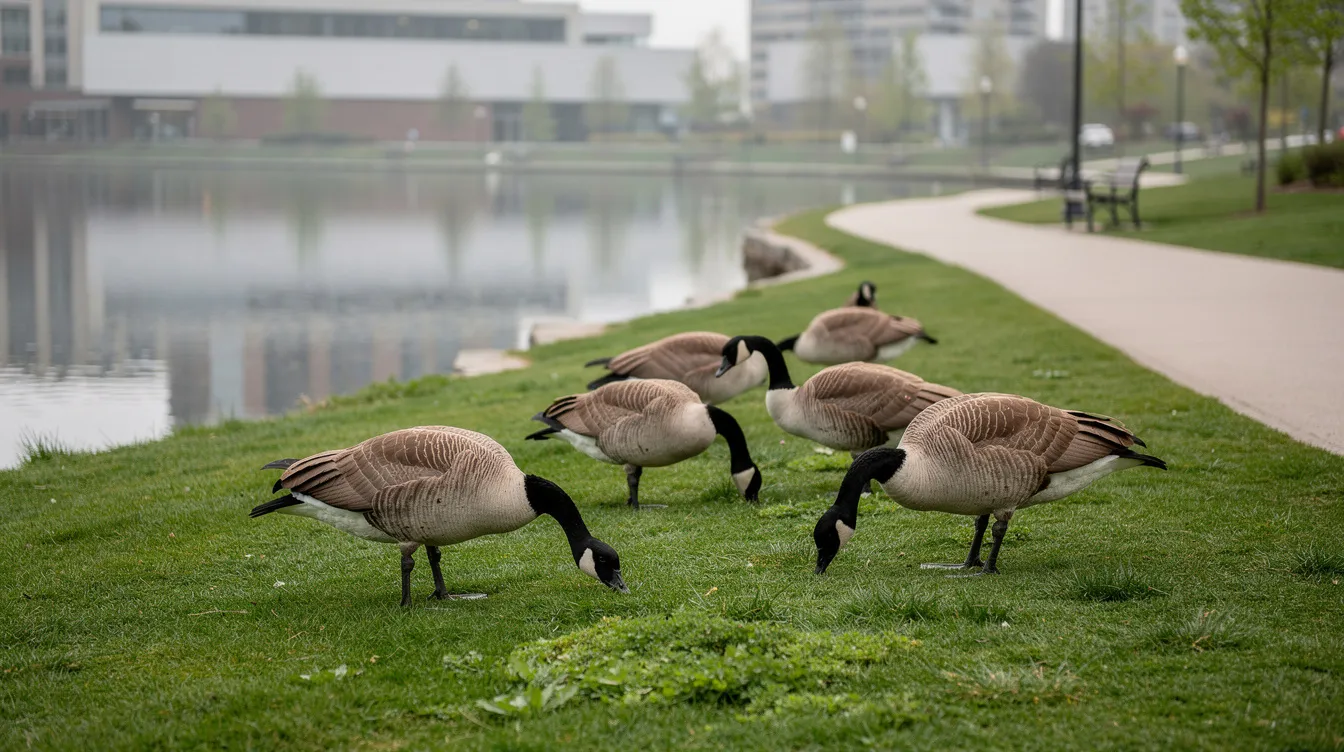
- Turf and landscape damage. Geese prefer lawns shorter than 6 inches for feeding, and continuous grazing and trampling by family groups create bare patches, compacted soil, and muddy zones on sports fields, school lawns, and golf fairways. Reseeding and repair costs accumulate quickly on heavily used grazing areas.
- Slip-and-fall liability. Goose droppings accumulate on walkways, patios, docks, and outdoor staircases. A single adult goose can produce over a kilogram of droppings per day, and large groups turn paved surfaces into slip hazards that expose property owners and municipalities to potential litigation.
- Water quality degradation. Droppings add phosphorus, nitrogen, and bacterial loading – including E. coli – to stormwater ponds and beaches, contributing to algal blooms, poor water quality, and occasional recreational-water advisories. Goose droppings can lead to reduced water quality in retention basins that serve entire neighbourhoods.
- Behavioural conflicts. During nesting season, adult geese become territorial: hissing, charging pathways, and threatening people and pets near entrances, parking lots, and trails. Municipalities like Windsor and Oakville have documented repeated public complaints about aggressive geese blocking multi-use trails and park access points.
- Disease transmission. Canada geese can carry avian influenza during migration, posing biosecurity risks to commercial and backyard poultry operations. Goose droppings may contain pathogens affecting livestock, which is why the Ontario government advises strict biosecurity on farms near waterfowl habitat.
- Ecosystem displacement. Unchecked goose populations can displace other wildlife and other species from natural shorelines, degrade aquatic plants and native vegetation, and reduce habitat complexity that supports broader biodiversity.
Legal Protection and Permits for Managing Canada Geese
Canada geese are protected under the Migratory Birds Convention Act, 1994 and the Migratory Birds Regulations, 2022. These federal laws make it illegal to kill migratory birds, harm them, or destroy nests and eggs without authorization. Harming Canada geese requires permits from the Canadian Wildlife Service, and destruction of Canada goose eggs requires a federal permit – even when the birds are on your own private property in Brampton or anywhere else in Canada.
There is, however, a practical distinction between routine deterrents and regulated actions:
| Activity | Permit Typically Required? |
|---|---|
| Landscaping changes (taller grass, shrub buffers) | No |
| Installing fences or grid wires | No (check local building codes) |
| Non-injurious visual deterrents (flags, tape) | No |
| Loud noises, propane cannons, air horns | No federal permit, but check municipal noise bylaws |
| Egg oiling, addling, nest destruction | Yes – Canadian Wildlife Service permit |
| Roundup and relocation | Yes – Canadian Wildlife Service permit |
| Lethal control or culling | Yes – federal and state permits (damage or danger permits) |
Landowners can apply for permits for regulated population management when geese threaten aircraft safety, cause significant crop damage, or pose ongoing public safety risks. Provincial rules also apply: Ontario hunting regulations, firearm discharge restrictions, and municipal bylaws in cities like Brampton may limit noise devices or pyrotechnics. Permits are required for scaring or killing migratory birds causing damage in most structured programs.
Professional goose management companies and municipal programs – such as Windsor’s nest relocation initiatives or Oakville’s egg removal and roundup program – operate under Canadian Wildlife Service permits and help landowners remain compliant. Before attempting any lethal control or nest management, consult Environment and Climate Change Canada or a licensed wildlife professional.
Integrated Canada Geese Control: Strategy Before Tools
An effective response to canada goose problems begins with strategy, not gadgets. Integrated pest management for geese combines habitat modification, exclusion, harassment, repellents, and – where necessary and permitted – lethal tools into a long-term plan tailored to the specific site.
The process starts with a structured site assessment: mapping water bodies, lawn areas, walkways, playfields, favourite loafing zones, and flight paths used by resident Canada geese. Timing is critical. Deterrents should be introduced before geese establish nesting territories in spring; harassment and new barriers are most successful before nesting begins in early April or before large, flightless groups gather during the June–July moult.
Relying solely on one approach – a single propane cannon, one application of repellent, or a set of static decoys – usually fails because geese habituate to predictable stimuli, and because new birds can arrive from neighbouring properties. Local populations will find artificial food sources if community efforts fail to coordinate across adjacent sites. For large or complex properties such as corporate campuses, industrial parks, golf courses, or municipal parks, integrated plans are often developed collaboratively between property managers, municipalities, and specialist goose management contractors.
Commercial Canada Geese Mitigation in Brampton
Managing Canada geese on commercial properties—such as corporate campuses, golf courses, and industrial parks across Brampton—requires a highly structured, legally compliant approach that differs significantly from residential deterrence. Expansive manicured lawns and large retention ponds frequently attract overwhelming flocks, leading to severe operational disruptions, hazardous slip-and-fall liabilities from excessive droppings, and aggressive territorial behavior toward employees and patrons during the spring nesting season.
Because Canada geese are federally protected under the Migratory Birds Convention Act, facility managers cannot unilaterally disrupt nests, relocate, or harm the birds. Effective commercial mitigation necessitates hiring a licensed wildlife management company. Professional technicians can design a comprehensive, IPM-approved goose management plan and secure the necessary federal Damage or Danger Permits from Environment and Climate Change Canada (ECCC) to authorize advanced hazing, egg addling, or strategic exclusion protocols.
Residential Geese Control in Brampton
While commercial properties battle expansive flock incursions, residential Canada geese conflicts in Brampton typically center around smaller shorelines, backyard swimming pools, and private lawns adjacent to local water features. For homeowners, the primary concerns are the aggressive territorial behaviours exhibited during the spring nesting cycle and the rapid accumulation of hazardous droppings on decks, patios, and walkways. Although the spatial footprint is smaller, residential properties remain strictly bound by the federal Migratory Birds Convention Act.
Homeowners cannot legally destroy nests, remove eggs, or relocate these protected birds themselves. Effective residential management focuses heavily on habitat modification—such as allowing shoreline grasses to grow taller to eliminate clear sightlines—and the deployment of approved exclusion barriers. When an active nest poses a direct safety threat to your family or pets, hiring a licensed wildlife control professional is critical. Our technicians navigate the complex federal permitting process on your behalf, securing the required Damage or Danger Permits to execute legal, humane nest management and exclusion strategies that permanently deter geese from reclaiming your residential property.
Habitat Modification: Make Your Property Less Attractive
Habitat modification is the foundation of managing canada geese and often the most sustainable, low-conflict method for reducing resident flocks over time. Geese prefer short, manicured lawns near water bodies for clear sightlines – specifically, turf shorter than six inches gives them unobstructed views of approaching natural predators while providing their preferred forage.
Key habitat strategies for southern Ontario properties:
- Grow taller grass. Let grass grow to 10–14 inches along shorelines and pond edges to deter geese. Allowing turfgrass to grow discourages geese from grazing by blocking sight lines and reducing palatability. Even allowing grass to reach 4 to 10 inches tall provides measurable deterrence.
- Plant dense shoreline buffers. Planting dense shrubs along shorelines can block geese access to grazing areas, and use shrubs to block geese’s line of sight to water. Avoid creating small islands or peninsulas that make ideal nesting sites.
- Replace preferred turf. Plant less palatable grasses like tall fescue or interplant with native bunch grasses, junipers, and wildflower beds around key conflict zones such as playground borders and building entrances.
- Reduce fertilizer. Reducing fertilizer use lowers the nutritional value of grass, making it unappealing to geese. This also reduces the lush, nitrogen-rich Kentucky bluegrass growth that canada geese tend to select.
- Plant trees around ponds to obstruct geese’s flight paths and make landing approaches more difficult. Remove bird feeders from areas near water, as scattered seed draws geese closer.
- Convert mowed lawn to naturalized plantings or no-mow zones that separate water from high-use areas. Municipalities like Oakville already use habitat modification – taller shoreline vegetation and reduced mowing – as core tools in their goose management programs.
Landscaping changes should be permanent, visually intentional (to look landscaped, not neglected), and coordinated with any homeowners’ association or municipal standards.

Exclusion: Physical Barriers That Limit Goose Access
Exclusion uses physical structures to prevent geese from easily walking between water and lawns or onto sensitive areas like sports fields, patios, and playgrounds. Because geese spend most of their time on the ground – especially during the flightless moult – barriers that interrupt their preferred straight-line travel routes are highly effective.
- Low fencing. Install fences at least 30 inches tall to prevent geese access. Welded-wire, plastic mesh, or post-and-rope barriers along pond edges or between water and turf effectively discourage geese from crossing. Fences should be at least 30 inches tall to deter geese reliably.
- Electric fencing. For agricultural or industrial sites, two-strand electric fences with wires at approximately 20 cm and 40 cm (8 and 16 inches) above ground provide strong deterrence but require professional installation, visible warnings, and compliance with local regulations.
- Overhead grid-wire systems. Stringing overhead grids disrupts geese’s landing and takeoff patterns on small ponds or narrow water features. Use single 14-gauge wire or strong monofilament (80–100 lb test) spaced roughly 3–5 m apart and 30–45 cm above the surface. Add visible markers – bright flags, reflective tape – to prevent collisions by other wildlife.
- Residential options. Temporary snow fencing, decorative picket fences, or dense hedges between lawns and water interrupt the straight path geese prefer, particularly during the moulting period when adult geese cannot fly.
Exclusion can be integrated into attractive landscape designs. A well-placed hedge or decorative fence serves double duty as aesthetic improvement and goose barrier.
Harassment and Frightening Devices
Harassment – also called hazing – involves actively encouraging canada geese to leave through repeated, varied disturbance. It works best before nests are established and should always be humane and non-injurious. Consistency and variation are essential; otherwise, geese quickly habituate, especially on large lawns in corporate parks, condo complexes, or golf courses.
Common tools to frighten geese and scare birds include:
- Auditory devices. Air horns, starter pistols, pyrotechnic cartridges (where legal), propane cannons, and loudspeakers broadcasting predator or distress calls. Using auditory systems helps scare geese from sensitive areas. Many loud noises are restricted by local noise bylaws in cities like Brampton – confirm municipal rules and coordinate with neighbours before deploying high-volume devices.
- Visual deterrents. Visual deterrents like flags and balloons can scare geese away temporarily, along with Mylar tape, predator effigies, and eye-spot balloons. These must be moved regularly to remain effective.
- Lasers. Green or red lasers used at dawn and dusk can startle geese off water and lawns. Effective in low-light conditions but useless in daylight.
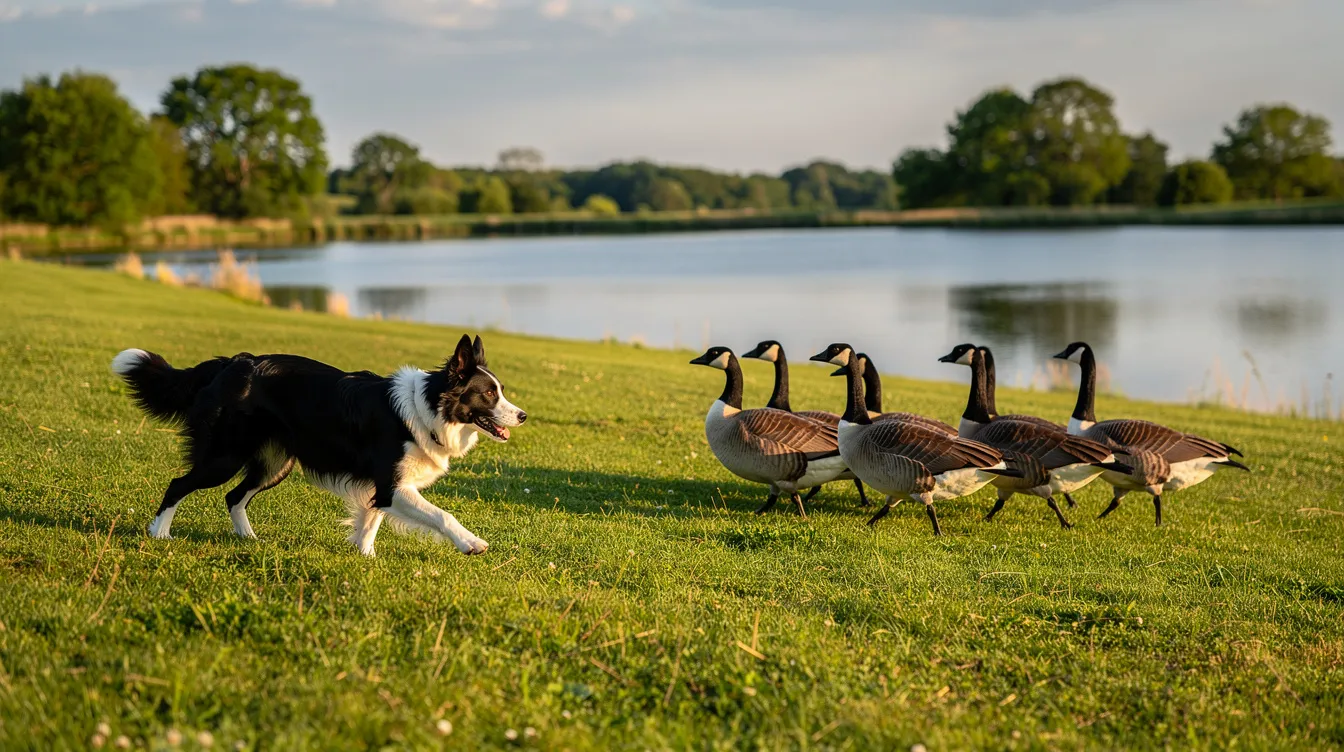
- Trained herding dogs. Dogs trained to chase geese can effectively control their populations on fields and shorelines. Geese can be scared away using trained dogs effectively, and border collies are the most commonly employed breed. Dogs must be professionally handled to focus on moving, not catching, young birds or adult geese.
- Advanced options. Remote-controlled boats on ponds, radio-controlled aircraft, and long-range acoustic devices are used by professional contractors on large-scale sites.
Harassment should generally not target geese that are actively nesting or goslings and flightless, moulting adults – both for welfare reasons and because it is largely ineffective once family groups are established.
Repellents: Making Grass Less Appealing
Registered chemical repellents for canada geese work by making treated grass taste unpleasant or by causing mild digestive discomfort, prompting geese to feed elsewhere. Chemical repellents like methyl anthranilate make grass unpalatable to geese. Anthraquinone is another active ingredient that causes brief gastrointestinal upset and learned aversion. Both are applied as sprays or fogs to lawns and sometimes water edges.
Key limitations to understand:
- Many repellent products in Canada require application by licensed or provincially certified pesticide applicators, particularly on commercial properties, golf courses, and municipal public parks.
- Reapplication is needed after mowing or heavy rain, and cost per square metre can be prohibitive across large properties.
- Caution is essential around ponds that support fish or sensitive aquatic plants; label directions and provincial pesticide regulations must be followed to protect non-target species.
- Repellents are often best suited for high-value, small target areas near building entrances, patios, play areas, or specific fairways – not entire campuses. They should always be paired with habitat modification and harassment to discourage geese from simply shifting to untreated grassy areas nearby.
Lethal Control, Hunting, and Why “Killing Geese” Is a Last Resort
While the public often searches for ways to kill canada geese, lethal control is heavily regulated in Canada and is rarely appropriate for individual homeowners. It is illegal to kill Canada geese without a permit, and killing geese outside sanctioned programs carries significant legal consequences.
In Ontario, legal hunting seasons for canada geese are set by the federal government and provincial authorities. Hunters require a Migratory Game Bird Hunting Permit, a federal stamp, and must comply with municipal firearm discharge bylaws. Hunting is effective at reducing local goose populations within regulated frameworks – more than 500,000 Canada geese are hunted in Canada annually, and over 500,000 Canada geese are hunted annually across the country as part of managed harvest programs.
Outside open hunting seasons, any lethal methods – culling resident geese, sharpshooting on problem sites, or structured scare-shooting – require specific federal damage or danger permits and professional implementation. Lethal control methods require federal and state permits without exception. Toxicants (poisons) are not registered for Canada goose control in Canada or the United States; using any homemade or unapproved toxic bait is illegal and dangerous to humans, pets, and non-target wildlife. Geese can be humanely euthanized and processed for food only within sanctioned, permitted programs.
Municipal examples exist where lethal or semi-lethal controls are integrated into larger management plans – combining egg management, roundups, and habitat changes – but these are multi-agency efforts coordinated with the Canadian Wildlife Service, not DIY options for private properties. Ethical and public-relations considerations are significant: lethal controls are often controversial and must be paired with strong communication and non-lethal efforts to maintain public trust.
Nest and Egg Management for Resident Canada Geese
Controlling reproductive success through egg oiling, addling, puncturing, or nest removal can gradually reduce local resident goose populations, but every step requires strict legal compliance. Egg addling can reduce local goose populations over time when conducted consistently across multiple breeding seasons – often five to ten years for noticeable population-level effects.
The typical process used by municipalities like Oakville or Windsor involves locating nests during early incubation in April–May, applying food-grade corn oil to eggs under permit from the Canadian Wildlife Service, and recording treated nests for annual reporting. Coating the shell with oil blocks gas exchange, preventing embryo development. This allows the female goose to continue incubating for a normal period before abandoning the nest, which helps prevent hatching without triggering immediate renesting.
Any handling of nests or eggs – including attempts to destroy or relocate them – is illegal without a federal permit, even on private property. Property owners who consistently experience nesting near doorways, rooftop planters, or parking lots should contact local wildlife authorities or licensed goose management professionals early in the spring to discuss permitted options. Nest management is most effective when integrated with habitat changes, exclusion, and harassment rather than used as a standalone tool.
Relocation, Roundups, and Municipal Goose Programs
A goose “roundup” involves capturing large groups of flightless adult geese and goslings during the June–July moulting period and relocating geese to designated wetlands outside urban cores. Roundups of Canada geese are most effective during their molt, when birds can be hand captured and herded into portable pens. Windsor, for example, contracted in 2025 for goose relocation to three sites outside the city, pending a Canadian Wildlife Service permit.
The capture process involves herding geese into temporary enclosures or using specialized netting, loading them into ventilated trailers, and transporting them to pre-approved release sites. However, geese often have strong homing instincts and geese may return in subsequent seasons, which is why roundups are typically only one component of long-term strategies.
Relocation and roundups can only be carried out under Canadian Wildlife Service permits – not by private homeowners. Residents experiencing significant conflicts in suburban areas should report problem geese in public spaces to their city’s 311 system so issues can be documented. Roundups and relocations are increasingly paired with egg management, habitat modification, and public education – including enforcing no-feeding bylaws helps control goose populations at the community level.
Health, Safety, and Clean-Up of Goose Droppings
While goose droppings are primarily an aesthetic and nuisance issue, heavy accumulations create hygiene and slip hazards requiring systematic management. Goose droppings can accumulate in parks and beaches to levels that trigger advisory notices and restrict recreational access. Droppings contribute nutrients and bacteria to stormwater ponds, and congregations of migratory birds including canada geese can play a role in spreading diseases such as avian influenza to domestic poultry operations.
Research found no significant health threats from goose feces to the general public in most exposure scenarios, but basic precautions remain important. Slip-and-fall risks on paved walkways, wooden boardwalks, and docks carry real liability for property owners and municipalities.
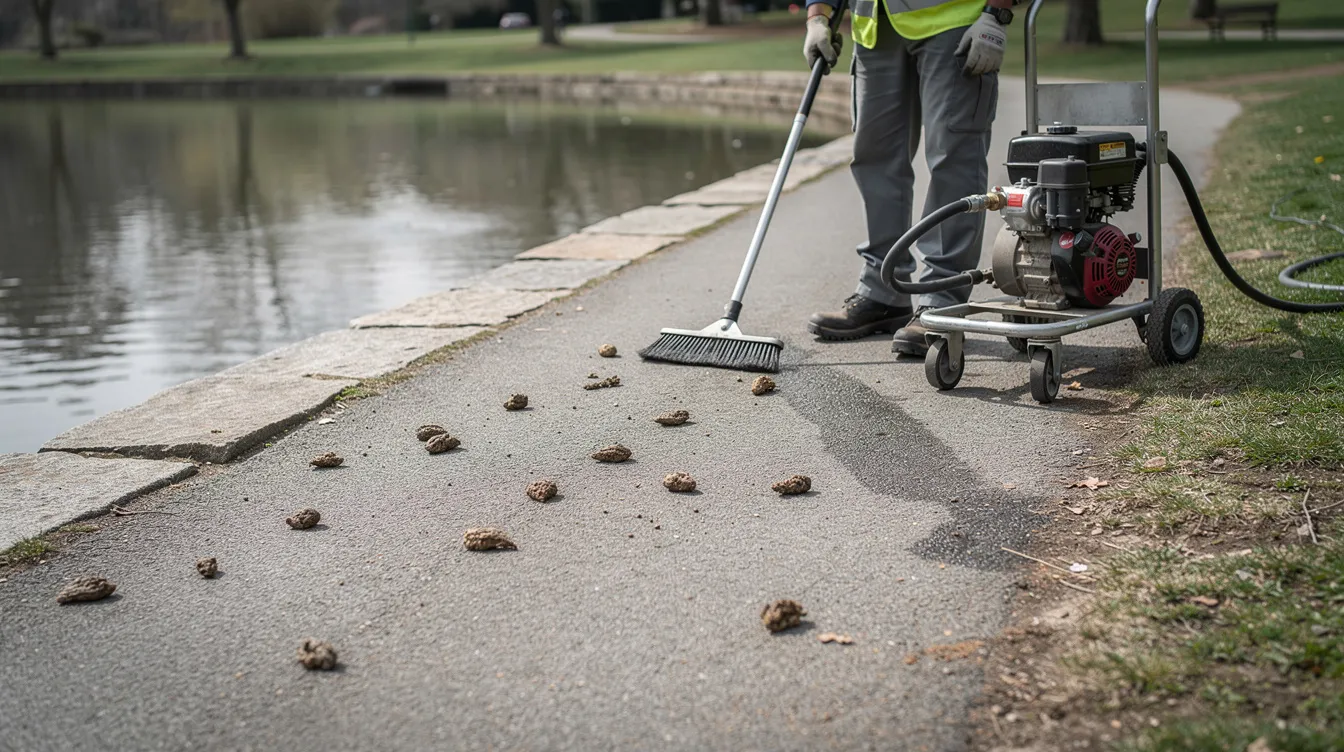
Best practices for clean-up include using protective gloves, masks when disturbing dry droppings, low-pressure water, and mechanical sweepers. Some municipalities use turf sweepers or specialized vacuum equipment in high-use areas. Commercial properties may contract professional cleaning and disinfection services. Clean-up alone, however, does not solve the underlying problem – it must be combined with the prevention and control strategies detailed throughout this article to significantly reduce ongoing accumulation.
When to Call a Professional Goose Management Service
Professional, humane goose control provided by companies like AAA Affordable Wildlife Control is the safest and most efficient choice for property owners who are overwhelmed, unsure of legal requirements, or responsible for high-traffic sites with liability exposure. Common scenarios where expert help is strongly recommended include:
- Aggressive geese near school or hospital entrances
- Persistent flocks on condo or office-park lawns
- Heavily contaminated playgrounds or sports fields
- Large commercial or industrial sites near water
- Any situation involving how many birds constitute a flock too large for DIY deterrence
Specialist goose management providers differ from general pest control companies in that they focus on long-term, site-specific programs using permitted methods: trained dogs, structured harassment schedules, habitat design advice, and coordination with federal permitting processes. Ask potential providers about their experience with federal permits, their commitment to humane and non-lethal methods, and their approach to ongoing monitoring.
Professionals can help design written management plans that align with federal regulations, provincial guidance, and local bylaws – giving property owners a defensible due-diligence record that protects against both regulatory enforcement and civil liability.
Frequently Asked Questions About Canada Geese Control
Is it legal to remove or destroy a Canada goose nest on my Brampton property?
Removing, destroying, or tampering with a Canada goose nest or eggs is illegal anywhere in Canada – including Brampton – without a federal permit under the Migratory Birds Convention Act and Migratory Birds Regulations. Homeowners who discover nests in unsafe or high-conflict areas such as building entrances, rooftop gardens, or daycare yards should contact a licensed wildlife professional or Environment and Climate Change Canada. Municipalities sometimes include private properties in their permitted egg-oiling or nest-management programs, but only with the owner’s consent and under strict reporting requirements.
Can I just feed the geese somewhere else so they leave my yard alone?
Feeding Canada geese is strongly discouraged and is prohibited by bylaw in many Ontario municipalities. Public education campaigns against feeding waterfowl should be implemented and enforced at the community level. Hand-feeding or scattering grain teaches geese to associate humans with food, which increases conflicts in parking lots, playgrounds, and patios rather than reducing them. Focus on habitat modification and exclusion to reduce conflicts on your own property.
Do Canada geese actually pose a risk to human health?
For most casual park users, the primary issues are nuisance, surface contamination, and slip hazards. Research found no significant health threats from goose feces to the general public in typical exposure scenarios. However, congregations of migratory birds can play a role in spreading diseases such as avian influenza to domestic poultry – which is why farms follow strict biosecurity guidelines. Basic hygiene is recommended: avoid direct contact with droppings, wash hands after visiting heavily used parks, and keep children and pets away from areas with visible fecal contamination.
What is the best time of year to start managing resident Canada geese?
The most effective time to start a new goose control program in Ontario is late winter to very early spring – before nesting begins in April – so that geese do not become established on the property. Harassment is much easier before eggs are laid and before goslings hatch; once family groups are present, options narrow considerably. Late summer and early autumn are also productive windows to reassess habitat and exclusion measures before the next breeding season.
Do methods like lasers, loudspeakers, or decoy predators really work on geese?
Many visual and auditory deterrents can work in the short term but are rarely effective as stand-alone, long-term solutions. Geese quickly learn to ignore devices that are static, predictable, or not backed up by real consequences such as active harassment with trained dogs or consistent human presence. View these tools as part of a broader integrated plan – combined with habitat changes, exclusion, and ongoing management – rather than as “set and forget” gadgets.

Squirrel Removal, Bird Removal, Raccoon Removal,