Ontario is home to a remarkable diversity of wildlife, and few animals are as visible or as capable of exploiting residential structures as its squirrels. Whether you hear persistent scratching overhead at dawn or mysterious thumps after midnight, understanding which species is responsible is the critical first step toward protecting your property. This guide covers the five squirrel species most frequently encountered by Ontario homeowners, detailing their appearance, seasonal behaviour, nesting instincts, and the structural risks they pose.
- Ontario has five tree squirrel species regularly found near homes: eastern grey squirrel, American red squirrel, fox squirrel, northern flying squirrel, and southern flying squirrel.
- Four are tree squirrels or flying squirrels; the fox squirrel behaves partly as a ground feeder but still nests in trees. True ground squirrels and chipmunks are less common around houses.
- Eastern grey squirrels (Sciurus carolinensis) and red squirrels are the species most likely to occupy attics, soffits, and roof cavities in Ontario cities and towns.
- Flying squirrels (Glaucomys sabrinus and Glaucomys volans) are strictly nocturnal-hearing scratching in the attic at night often points to a flying squirrel colony rather than mice.
- All five species can create structural damage, contamination, and fire risks. Humane, professional exclusion remains the safest and most effective response for homeowners.
Overview of Squirrel Species in Ontario
Squirrels are rodents belonging to the family Sciuridae, a group encompassing approximately 285 species worldwide. Squirrel species in Ontario vary significantly in size, behaviour, and habitat, but five are regularly encountered around residential properties. These fall into two broad ecological groups relevant to homeowners: tree squirrels (including flying squirrels), which nest above ground and remain active year round, and ground squirrels, which burrow underground and often hibernate. This article focuses on the five tree and flying squirrel species most often found near houses.
The five focal species, listed by common and scientific name, are:
- Eastern grey squirrel (Sciurus carolinensis)
- American red squirrel (Tamiasciurus hudsonicus)
- Fox squirrel (Sciurus niger)
- Northern flying squirrel (Glaucomys sabrinus)
- Southern flying squirrel (Glaucomys volans)
Ontario has five tree squirrel species, and notably, the black squirrels so commonly seen in Toronto and other cities are a melanistic colour form of the eastern grey squirrel, not a separate species. These different species of squirrels thrive in southern and central Ontario, especially in mixed hardwood forests, urban parks, and older neighbourhoods with mature trees providing plentiful food sources and natural spaces for nesting.
Tree Squirrels in Ontario
Tree squirrels are arboreal animals adapted for climbing trees, building nests in canopy cavities, and navigating vertical surfaces with extraordinary agility. They possess bushy tails that aid in balance and thermoregulation, and their ankle joints can rotate nearly 180 degrees, allowing head-first descent. Tree squirrels are active year-round and do not hibernate, unlike their ground-dwelling relatives. Tree squirrels build nests called dreys-compact spheres of leaves and bark wedged into branch forks-or occupy tree cavities when available.
From a homeowner’s perspective, these climbers exploit overhanging branches, rooflines, soffits, fascia boards, roof vents, and gaps around chimneys to gain access to attic voids. The three main tree squirrels in Ontario are eastern gray, red, and fox squirrels, each profiled below.
Eastern Grey Squirrel (Sciurus carolinensis)
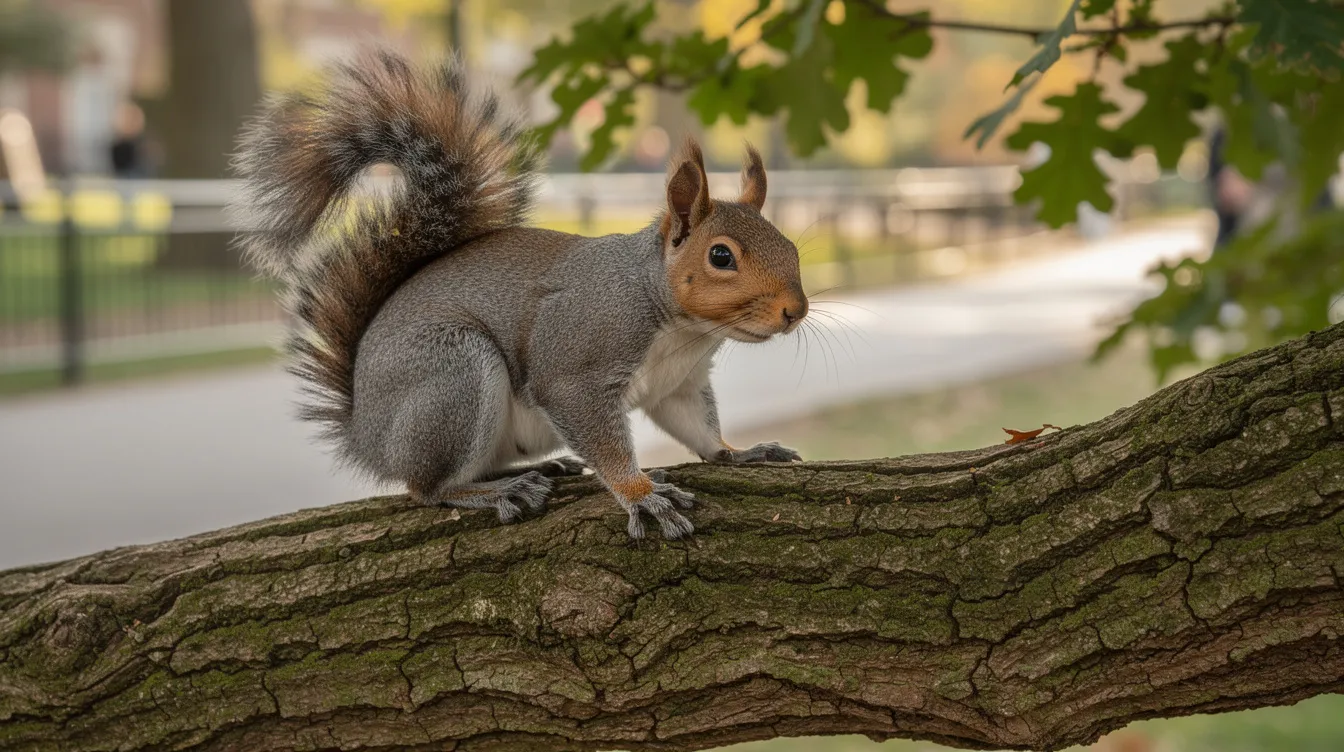
Eastern grey squirrels are the most common in Ontario and the species most frequently responsible for squirrel problems in urban areas like Toronto, Ottawa, Hamilton, and London. This medium-sized tree squirrel has a body length of roughly 23–30 cm, grey or grey-brown fur with occasional brownish highlights, and a white or pale belly. The melanistic morph, commonly called a “black squirrel”-is genetically identical in behaviour and reproductive timing.
Eastern grey squirrels are diurnal and boldly habituated to humans, readily raiding bird feeders, gardens, and compost bins. They eat nuts, seeds, fruit, and occasionally insects and bird eggs. As natural forest regenerators, eastern grey squirrels plant countless trees by burying seeds they later fail to retrieve-an ecological role that makes them vital to forest health.
Eastern grey squirrels have two breeding seasons each year in Ontario: late winter (January–February) and midsummer (June–July). Gestation lasts approximately 40–44 days, producing average litters of three young (range one to six). Baby squirrels are born hairless and blind, with eyes opening around day 28–35 and weaning occurring at roughly 8–10 weeks. Only females over two years old regularly produce two litters per year.
Inside homes, gray squirrel intrusion typically begins with chewing through soffits, fascia, or roof vents. Once inside, they gnaw on electrical wiring, compress insulation, store food in wall cavities, and leave droppings throughout the attic. Persistent daytime scrabbling, chewed fascia boards, and tubular droppings approximately 1 cm long are reliable early signs. Because breeding occurs twice annually, exclusion must be carefully timed to avoid orphaning dependent juveniles, making professional inspection essential before sealing entry points.
Red Squirrel (Tamiasciurus hudsonicus)
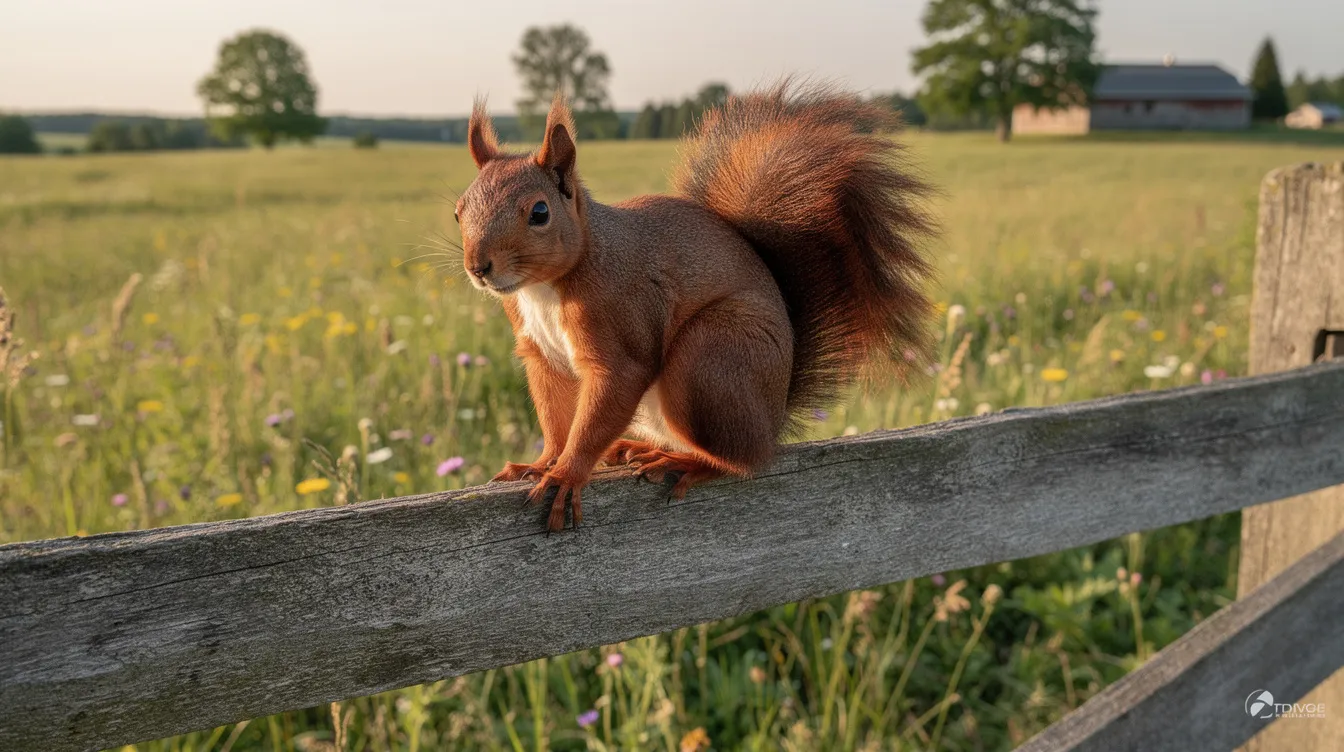
American red squirrels are smaller and more territorial than grey squirrels, with a compact body, rusty-red back, white or cream belly, and a loud, rapid-fire chattering call that carries across wooded areas. Red squirrels prefer coniferous forests for foraging, thriving in spruce, pine, and mixed stands from cottage country through the boreal forests of northern Ontario. They are found in coniferous forests and do not hibernate, remaining active year-round even in severe cold weather.
Red squirrels are larder-hoarders: they accumulate massive central food caches called middens, piles of cone scales, nuts, and dried mushrooms, and defend them aggressively against other squirrels and other species that venture too close. Wildlife professionals often rank them as Ontario’s most “feisty” squirrel species, though direct attacks on humans are rare and almost always defensive.
Structurally, red squirrels chew into roof edges, soffits, and wall cavities to build nests close to their food sources. They may pack insulation voids with stored cones, which can obstruct vents, retain moisture, and attract insects or mould. Breeding typically occurs in late winter (February–March), with a possible second litter in summer if food is plentiful. Average litter size is four to five young. In autumn, they commonly move into cottages, sheds, and garages in rural areas to secure winter shelter.
Homeowners should never block active entry holes during baby season without first confirming whether juveniles are present. Professional inspection is needed before any exclusion work proceeds.
Fox Squirrel (Sciurus niger)
Fox squirrels are the largest tree squirrels in Ontario, with a stocky build, reddish-grey or grizzled brown fur, an orange-red belly, and tail fringes that distinguish them from other species at a distance. Their body length exceeds that of grey squirrels, and their proportionally longer tail sets them apart from the compact red squirrel.
In Canada, fox squirrels have a highly restricted range, centred on Pelee Island, where a population has persisted since approximately 1890, and scattered pockets of Carolinian forest in southwestern Ontario. They favour open woodlots, large deciduous trees, field edges, and some parks in southern regions, performing poorly in dense forest interiors compared to mosaics of open and forested land.
Fox squirrels are diurnal and forage more on the ground than other tree squirrels, seeking acorns, walnuts, and corn waste. Their movements are generally slower and more deliberate than the acrobatic grey squirrel. The risk of structural intrusion is lower than for grey or red squirrels but still exists, particularly in rural homes, barns, and older farm buildings where trees overhang rooflines. Because they have powerful jaws, any entry they create or enlarge through chewing can be substantial. Prevention steps: trimming branches, sealing eaves, mirror those for grey squirrels.
To distinguish them quickly: fox squirrels are noticeably larger and more orange-red than grey squirrels, and significantly larger and less vocal than red squirrels. If you spot a large, slow-moving, reddish-grey squirrel in southern Ontario, a fox squirrel is the likely identification.
Flying Squirrels in Ontario (Glaucomys sabrinus & Glaucomys volans)
Ontario is home to two flying squirrels: the northern flying squirrel (Glaucomys sabrinus) and the southern flying squirrel (Glaucomys volans). Unlike the three-day-active tree squirrels above, both flying squirrels are strictly nocturnal and rarely seen by homeowners, despite sometimes living in significant numbers inside attic voids.
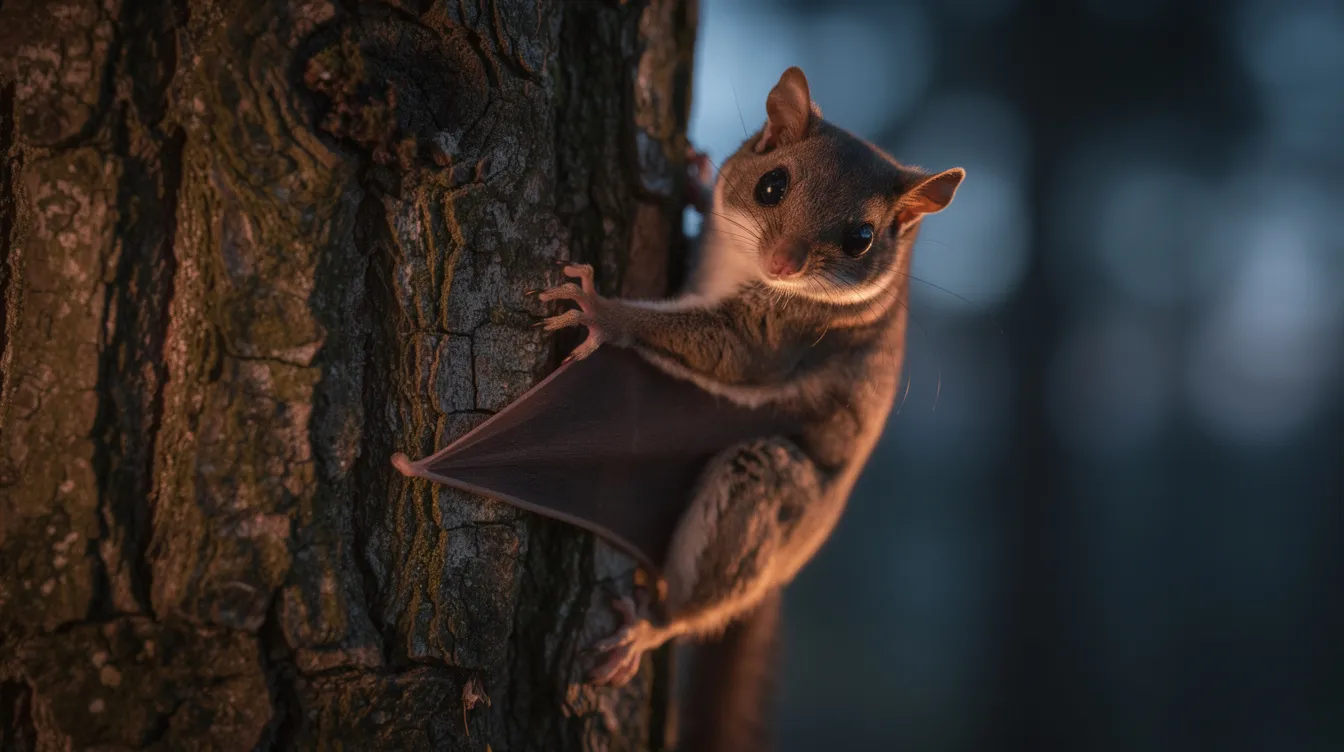
Their most distinctive anatomical feature is the patagium-a membrane of skin stretching between front and hind limbs that enables controlled gliding. Flying squirrels can glide for distances up to 50 metres between trees. They possess large eyes adapted for night vision and soft, silky fur. The northern flying squirrel is slightly larger (total length approximately 25–30 cm; weight 75–125 g), while the southern flying squirrel is smaller (approximately 20–25 cm; weight 50–90 g).
The northern flying squirrel glides between trees and prefers mature forests-particularly boreal and northern mixed stands, and plays a key role in dispersing fungi spores that are critical to forest-floor ecology. Northern flying squirrels require nest cavities for habitat, using old woodpecker holes and snags. The southern flying squirrel occupies more deciduous and mixed hardwood forest in southern Ontario, sometimes extending into suburban woodlots. Research from SUNY-ESF documents increasing range overlap in southern Ontario, likely driven by climate change.
Southern flying squirrels share nests in winter to conserve heat, forming aggregations of four to ten individuals-a behaviour that amplifies noise and contamination when colonies establish inside attics. Studies in southern Ontario found that approximately 85.7% of northern flying squirrel nest cavities were lined with shredded Eastern White Cedar bark, possibly for ectoparasite control.
What homeowners actually notice from flying squirrels is scratching, scurrying, and light thumps in attics between dusk and dawn, along with small droppings and faint ammonia odours. Because they are rarely spotted in daylight, many species misidentifications occur; homeowners assume mice or rats are the culprit. Professional species identification is critical before any control work begins, and humane eviction must account for colony living and breeding periods (northern flying squirrels breed March–May; litters of two to four young weaned by approximately 60 days).
Ground Squirrels and Other Burrowing Relatives
While this article focuses on the five primary tree and flying squirrel species, true ground squirrels and related burrowing rodents also occur in Ontario. Ground squirrels have less bushy tails and more robust hind feet compared to their arboreal cousins.
Key examples include:
- Thirteen-lined ground squirrel – these ground dwelling squirrels live in burrows and open fields, favouring agricultural land and golf courses. They are among the most recognisable of ground squirrels, though less frequently encountered near homes than tree species.
- Eastern chipmunks – Eastern chipmunks are ground-dwelling members of the squirrel family. Chipmunks are recognised by the five black stripes on their back and are common in gardens, rock walls, and woodland edges. The least chipmunk, a related but smaller species, is more typical of northern and western regions.
Ground squirrels dig burrows for shelter and food storage, and ground squirrels typically hibernate during the winter months-a sharp contrast to tree squirrels that remain active. Ground squirrels aerate soil through their burrowing activities, providing a genuine ecological benefit. Homeowner concerns with ground dwelling squirrels centre on tunnels undermining patios, walkways, or shed foundations, along with soil mounds and holes in lawns and gardens. Although they rarely invade the structural envelope of a house, heavy burrowing near foundations can attract predators such as owls and foxes and create tripping hazards, warranting professional assessment.
Seasonal Nesting, Activity Patterns, and Structural Vulnerabilities
Understanding when and how different species move, breed, and store food helps homeowners time prevention and exclusion work effectively.
Activity patterns: Eastern gray, red, and fox squirrels are diurnal, most active at dawn and dusk. Flying squirrels are active exclusively at night. The timing of noises in your attic is one of the fastest ways to narrow down which species is present.
Breeding timelines for Ontario species:
| Species | Primary Breeding | Second Litter? | Avg. Litter Size |
|---|---|---|---|
| Eastern gray | Jan–Feb | Jun–Jul | 3 (1–6) |
| Red squirrel | Feb–Mar | Possible summer | 4–5 |
| Fox squirrel | Late winter | Occasionally | 3–4 |
| Northern flying | Mar–May | Rare | 2–4 |
| Southern flying | Early spring | Sometimes | 2–4 |
Most squirrels reproduce once annually in Canada, but eastern grey squirrels are a notable exception with two breeding seasons. Gestation lasts 24 to 44 days for most squirrel species, and litters typically consist of three to eight young squirrels. Young squirrels are born hairless and blind across all species, remaining dependent in the nest for 8–12 weeks.
Structural vulnerabilities that squirrels exploit include gaps in soffits and fascia, deteriorated roof vents, uncapped chimneys, warped eave boards, and flashing gaps around dormers and skylights. In late winter and early spring, pregnant females intensify gnawing on potential entry points as they seek secure den sites. Many species display heightened food-hoarding behaviour from late summer into autumn, which also drives them to explore roof cavities and wall voids.
Scheduling exclusion outside peak baby season is ideal. The safest method combines one-way doors-devices that let animals exit but prevent re-entry-with permanent sealing of all vulnerabilities once the structure is confirmed vacant.
Health Risks, Damage, and Biohazard Concerns
Ontario’s squirrel species are integral to healthy ecosystems, but infestations inside homes pose genuine health and safety risks.
Structural and fire hazards:
- Squirrels can chew through electrical wiring, exposing conductors and creating ignition sources.
- Squirrels can create fire hazards by nesting in chimneys, where dry nest materials sit near flue heat.
- Squirrels may cause structural damage by nesting in attics, gnawing on wood framing, fascia, and soffits.
- Squirrels often damage insulation in homes, compressing or soiling it and reducing energy efficiency.
Biohazard concerns:
- Squirrels can leave droppings throughout homes, particularly in attic corners and wall cavities.
- Accumulated urine produces ammonia odours that permeate living spaces.
- Squirrels can carry ectoparasites-fleas, ticks, mites-that may spread diseases or transfer to prey animals and pets.
- Dead animals trapped inside walls during failed DIY exclusion attempts produce severe decay odours and attract secondary pests such as flies and beetles.
Proper cleanup involves protective equipment, HEPA-filter vacuuming, and replacement of heavily contaminated insulation. These steps go beyond what most homeowners can safely accomplish without professional support.
Humane Removal, Exclusion, and Prevention for Ontario Homeowners
Humane, professional intervention is the safest and most effective way to address any of Ontario’s squirrel species once they have entered a building. Attempting to relocate squirrels or trap wildlife without understanding nesting cycles, maternal behaviours, or provincial regulations frequently worsens structural damage and causes unnecessary distress to the animals.
A typical professional process includes:
- Thorough inspection to identify the species and locate all entry points.
- Installation of one way doors or other humane eviction devices at active openings.
- Monitoring to confirm all animals, including juveniles, have vacated.
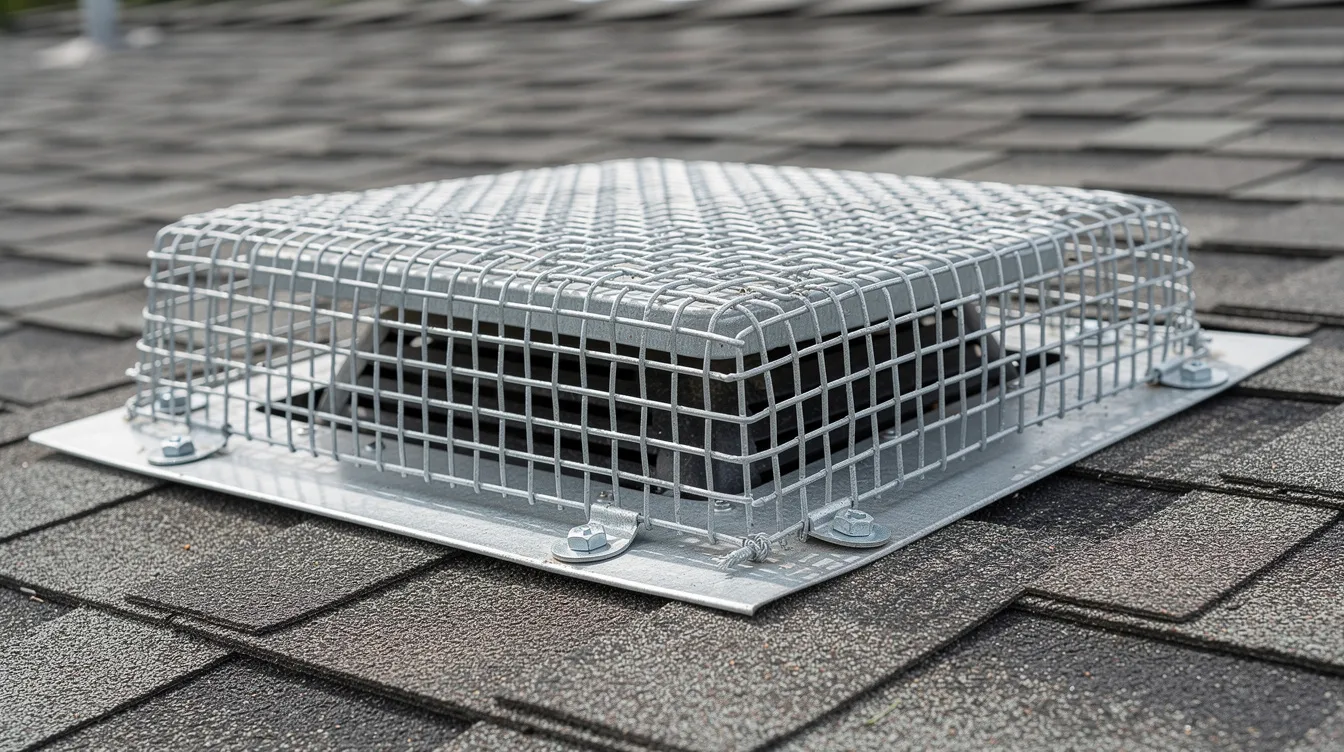
- Permanent sealing of vulnerabilities using galvanised steel mesh on vents, metal flashing on gnawed edges, and hardware cloth for soffit repairs.
Homeowner prevention tips:
- Trim tree branches at least two to three metres from rooflines to limit aerial access.
- Install squirrel-resistant bird feeders and secure garbage and compost containers.
- Conduct seasonal roofline inspections, ideally before the first hard frosts.
- Address rotted or warped fascia, loose vent covers, and damaged flashing promptly.
Legal and ethical considerations are important: lethal trapping, poisoning, or attempting to relocate squirrels long distances can be both ineffective and in violation of provincial wildlife regulations. When dealing with nocturnal flying squirrels, colony infestations, or situations where baby squirrels may be present, contacting a local, humane wildlife control company for tailored advice is always the recommended course of action.
Frequently Asked Questions about Ontario Squirrel Species
How can I tell which squirrel species is in my attic?
Identification combines several clues: timing of noises (daytime activity suggests eastern grey or red squirrels; exclusively nighttime sounds point to flying squirrels), size and shape of droppings (tree squirrel droppings are larger and tubular; flying squirrel droppings are smaller and often concentrated in “latrine” spots), and the size of entry points. Professional inspection can quickly differentiate among species and tailor a humane removal plan that accounts for breeding status and colony size.
Are black squirrels a different species in Ontario?
No. Most black squirrels in Ontario are melanistic eastern grey squirrels (Sciurus carolinensis), and occasionally melanistic fox squirrels. Their behaviour, nesting habits, and potential to cause home damage are identical to those of grey-coloured individuals. Identification for control and prevention purposes should always focus on species rather than colour morph.
Do any squirrel species in Ontario hibernate?
Tree squirrels and flying squirrels in Ontario do not hibernate. They remain active year-round, relying on cached food and insulated nests to stay warm through winter. In contrast, ground squirrels and some chipmunks enter hibernation or extended torpor in underground burrows. Hearing attic noises in mid-winter is perfectly consistent with gray or red squirrel activity and should not be dismissed.
Can squirrels in my home make my pets sick?
Squirrels can carry external parasites such as fleas and ticks, which may transfer to pets in wild areas where animals share access points. While direct disease transmission from squirrels to pets is relatively uncommon, droppings and urine create unsanitary conditions. Safe removal followed by professional cleaning and potentially veterinary advice reduces any risk to dogs and cats that frequent attics, garages, or crawlspaces.
When is the best time of year to squirrel-proof my home in Ontario?
Late summer and early autumn are ideal for prevention work, before squirrels intensify their search for winter nesting sites and food sources become scarcer. Exclusion can be done year-round, but extra care is required in early spring and midsummer to avoid separating mothers from dependent young. Scheduling a professional inspection at least once a year-ideally before the first hard frosts-catches new vulnerabilities early and ensures ongoing conservation efforts align with responsible, humane property protection.

Squirrel Removal, Bird Removal, Raccoon Removal,